
This article was published in the Association for Coaching’s, Coaching Perspectives Magazine, July 2026.
In this mesmerising story, Helen Teague shows us how travel frees up the mind and how experiences on the road can spark ‘balcony moments’ that enrich our coaching practice.
SPIRALLING
Nobody wants to be met at the airport with the words ‘The country you are entering is in a state of emergency’ but those were the words our friendly tour guide greeted us with in the airport arrivals hall. As we stepped into the waiting minibus the guide reassured us that it was still safe to travel and started highlighting points of interest, but I wasn’t really listening any more. My internal dialogue and thumping heart were way louder. My husband glanced at me with a reassuring smile. Like others around me, he wasn’t fazed. But you see I’m not the adventuring type. Travelling to a new country, thousands of miles from home was a big deal for me- out of my comfort zone- and all I could think as the minibus drove away from the bustling airport towards the shadow-filled rainforest was that I’d pushed my limits too far this time. My sense of adventure decreased as my sense of anxiety increased. Those 3 words, ‘state of emergency’ were reverberating around my head.
STEADYING
Appreciating we had a 90-minute journey ahead, I took steps to steady myself. I knew that in that moment the minibus was a safe space. I started to concentrate intentionally on my breathing and to look through the window at the stunning scenery, bringing myself into the present- re-finding a sense of balance.
SOARING
On arrival at the nature reserve way up in the rainforest, tired and uncertain, I wandered out onto the balcony and the most beautiful sight unfolded before my eyes. Hummingbirds- more than I could count- everywhere- darting around in all directions as they fed from an array of feeding stations. Their iridescent beauty and acrobatic agility captivated me. I became completely immersed, lost in this beautiful hummingbird encounter, remembering afresh that this was the reason I’d pushed myself out of my comfort zone. My heart soared and I noticed a shift inside me from anxiety to equanimity. Yes, the ‘state of emergency’ continued for this beautiful country, the world at large hadn’t changed but my view of it had. As Ralph Waldo Emerson so elegantly puts it: ‘In the woods, we return to reason and faith. There I feel that nothing can befall me in life, no disgrace, no calamity, which nature cannot repair.’1Emerson, R. W. (1836). Nature. Publisher: Boston: James Munroe and Company
DESIGN NOT CHANCE
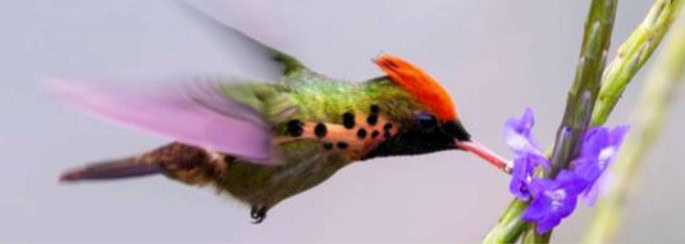
The next morning, I returned to the balcony, noticing what I thought at first to be an unusually beautiful butterfly on a verbena plant behind the manufactured hummingbird feeders. Moving closer, I realised it wasn’t a butterfly at all, but the tiniest hummingbird I had ever seen. The Head Naturalist later explained that the presence of this tiny hummingbird known as the Tufted Coquette, was down to design not chance. Having spent much time and effort setting up the initial feeding station, he had noticed from the vantage point of the balcony that this tiniest hummingbird was rarely seen and often missing. He realised, after further monitoring from the balcony, that because it was so small it couldn’t easily feed from the manufactured hummingbird feeders and was often knocked off or pushed out of the way by larger hummingbirds. To survive, it withdrew from the jostling feeding area to seek out the verbena plant- a natural resource growing further afield although not in plentiful supply.
With this fresh insight the Head Naturalist went back to the drawing board and intentionally redesigned the feeding station, this time creating a green infrastructure comprising the essential natural verbena specifically for the needs of the Tufted Coquette alongside the standard manufactured feeding stations benefiting larger varieties. So now the richest diversity of hummingbirds thrive individualy and co-exist side-by-side.
INSPIRED BY NATURE
Having arrived on the balcony tired and uncertain I spent my last day on the balcony inspired and reflective! The whole experience from spiralling to soaring influenced me as a human and a coach in three particular ways.
1. From tension to intention
Uncertainty gets a bad press, don’t you think? It feels as though the word and narrative around uncertainty is being weaponised headlines screaming ‘unprecedented uncertainty’ at us from the moment we wake up, increasing the potential for anxiety levels to rise without us noticing.
Certainly, my own experience on arrival at the airport reinforced the benefit of remembering that we have agency and can choose intentional steps that are congruent with our purpose in the given situation. Even though felt scared and anxious, remembering why I had wanted to put myself out of my comfort zone in the first place led me to my intentional choice to stay present in the moment, look at the unfolding scenery around me, and breathe slowly. To feel my feelings, steady myself and move towards uncertainty, versus turn back to the airport! Reminding me of the words frequently attributed to Abraham Maslow: ‘One can choose to go back toward safety or forward toward growth. Growth must be chosen again and again; fear must be overcome again and again.’
Now when working with clients I listen more closely for the stories they are telling themselves about uncertainty and encourage them to voice their fears. Holding and listening to the discordance in their hearts and staying alongside them as their new song emerges. Supporting them to uncouple anxiety from uncertainty, re-framing their uncertainty as an opportunity to make intentional and purpose-filled choices in that moment that their future self will thank them for. As a client fed back to me, ‘Rather than getting me to look forward you got me to place myself forward and look back; this somehow took pressure off what my immediate steps were.’
2. Balcony moments
Ronald Heifetz and Donald Linsky coined the phrase ‘Moving from the dance-floor to the balcony’ as part of the development of adaptive leadership theory, based on their research at Harvard University)2Heifetz and Laurie, (2001) Best of HBR, The Work of Leadership, Harvard Business School Publishing Corporation. The balcony is a space removed from the action but with a great view of the action. It provides a space from which to notice patterns in the system in focus. Who is dancing with whom? Who is standing at the side of the dance floor? Who is missing? A space for gaining/regaining perspective before rejoining the dance-floor with greater clarity and intention, just as the Head Naturalist did when he saw from the balcony that the Tufted Coquette was missing and he needed to redesign the feeding station.
I believe clients can benefit from building the habit of stepping onto the balcony for a moment – metaphorically. To take a fresh look at the dance-floor and notice what can only be noticed from the balcony. Simply asking clients to join me on the coaching balcony to gain a different perspective on the challenge they are grappling with helps to build this habit for them as part of their self-coaching toolkit beyond our coaching work together. A client reflected that our recent balcony coaching moment helped ‘lift the conversation above the specific issue and into a space of patterns/repeated feelings and behaviours.
3. The verbena touch
By deliberately redesigning a green infrastructure incorporating verbena alongside the manufactured hummingbird feeders, the Head Naturalist showed the Tufted Coquette that this feeding space was customised for them – that their needs were provided for, that they mattered – and that he cared. Now the Tufted Coquette frequents the space it had previously found unsafe, thriving in the purposefully designed habitat.
This insight has led me to reflect on the ‘greenness’ of the virtual coaching space I inhabit with clients. Like many of us I tumbled into the world of virtual coaching amidst the Covid pandemic feeling uncertain myself. While I am confident that the basics like stable wi-fi and virtual platform are covered, what about the ‘verbena touch’ for each client? Does the virtual environment cultivate sufficient safety for the clients to access their resources including the bravery needed to find their wings and fly in the turbulent conditions awaiting them? Ongoing CPD and personal commitment to honing my coaching skills is a given, but I’ve never asked clients about their needs in terms of the virtual coaching space itself – the habitat for our coaching work together. I’ve assumed it works. So, I’ve taken my own balcony moment on this matter, reflected on my own observations and intentionally inquired with clients about their experience of our virtual coaching space. What helps, hinders, is missing? The following points have emerged- shades of verbena to cultivate a greener coaching habitat going forward- a sanctuary for renewal and sustainable growth. What might you add?
- Virtual coaching sessions are scheduled to take place whilst clients are at home
- Clients use their preferred virtual platform
- Coaches accommodate with ease any time needed for technical adjustments
- Al functionality is switched off to support creation of a safe space
Coaches use real background versus picture or blur to foster a more genuine environment
- Coaches invite clients to sit back from the screen where physical space or headspace supports their processing of thoughts and emotions
FIND YOUR BALCONY
I wonder how you respond to uncertainty? I wonder which experience your mind goes to when you read that question? Perhaps you might seek out a balcony moment for yourself – in a local park, woodland or by the sea – for inspiration and restoration for your path ahead.